The University of Notre Dame Australia has awarded an Honorary Doctor of Letters to respected Noongar Elder, community leader and advocate Dr Robert Isaacs AM, recognising more than five decades of service to Aboriginal Australians across health, housing, justice, education and reconciliation.
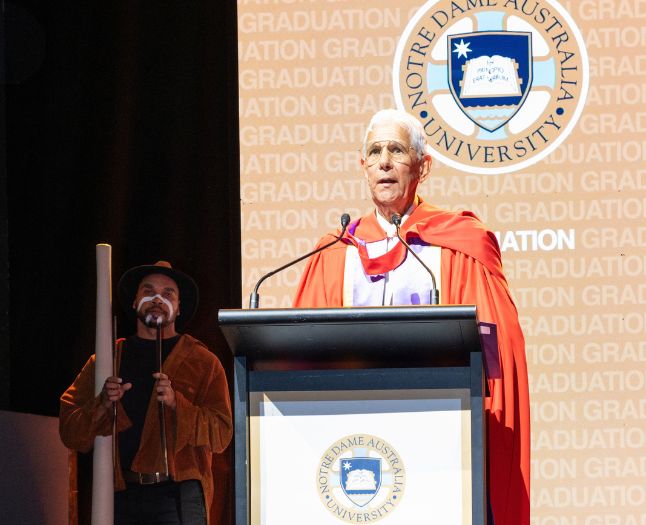
The honorary doctorate was conferred at the University’s Fremantle graduation ceremony in recognition of Dr Isaacs’ contribution to Australian society and his longstanding support of the University’s mission and values.
A highly respected Elder of the Whadjuk-Bibilmum Wardandi Noongar language group, Dr Isaacs has dedicated his life to improving opportunities, wellbeing and self-determination for Aboriginal people, while fostering stronger understanding between Aboriginal and non-Aboriginal communities.
In 1975, Dr Isaacs established the Aboriginal Medical Service Dental Clinic in response to a critical lack of culturally appropriate healthcare for Aboriginal people. The initiative helped pave the way for a network of Aboriginal-controlled health services that transformed access to care and informed future models of culturally safe healthcare delivery.
Through his leadership of major housing initiatives, more than 8,000 Aboriginal people have been supported to access stable and affordable housing. As a Director of Noongar Mia Mia, he has also helped deliver culturally appropriate housing solutions throughout Western Australia.
An advocate for justice, reconciliation and education, Dr Isaacs has worked extensively to mediate land rights and community disputes, improve relationships between Aboriginal communities and the justice system, and establish greater educational opportunities for Aboriginal young people, including helping to found Clontarf Aboriginal College, Australia’s first Indigenous school.
Dr Isaacs has also been a longstanding supporter of Notre Dame’s commitment to Aboriginal engagement and reconciliation, delivering the Nulungu Reconciliation Lecture in 2021 and regularly engaging with students and staff across the University's campuses.
Receiving the honorary doctorate, Dr Isaacs reflected on the power of education, particularly for Aboriginal people and communities.
“For Aboriginal people, education is not only about a certificate, a job, or a career,” Dr Isaacs said.
“It is also about dignity, independence and self-determination.
“When a young person gains an education, the benefit does not stop with that one person. It reaches parents and grandparents. It reaches brothers, sisters, cousins and children.
“Education becomes more than individual progress; it becomes community progress.”
Dr Isaacs said education also played a vital role in reconciliation and helping all Australians better understand the nation’s shared history.
“When education is grounded in truth and respect, it can challenge ignorance, build understanding and help bring people together,” he said.
“I have seen what education can do. I have seen it give young Aboriginal men and women the confidence to walk into places where they may once have felt they did not belong.
“I have seen it create teachers, health workers, tradespeople, public servants, community leaders, parents and role models.
“Take every opportunity to learn, hold fast to who you are and use your education in the service of others.”
Dr Isaacs thanked the University for the honour and acknowledged the many people who had supported him throughout his life and career.
“I accept this degree with gratitude and I share it with the many people who have put their trust in me over the years, my community, my colleagues, the Elders and leaders who guided me and those who have worked alongside me in the long journey of service.”
Dr Isaacs’ contribution has also been recognised through numerous honours, including the Centenary Medal, the Medal of the Order of Australia (OAM) and appointment as a Member of the Order of Australia (AM). In 2016, he was named Western Australian of the Year, Western Australian Aboriginal of the Year and NAIDOC Male Elder.
Media Contact: media@nd.edu.au