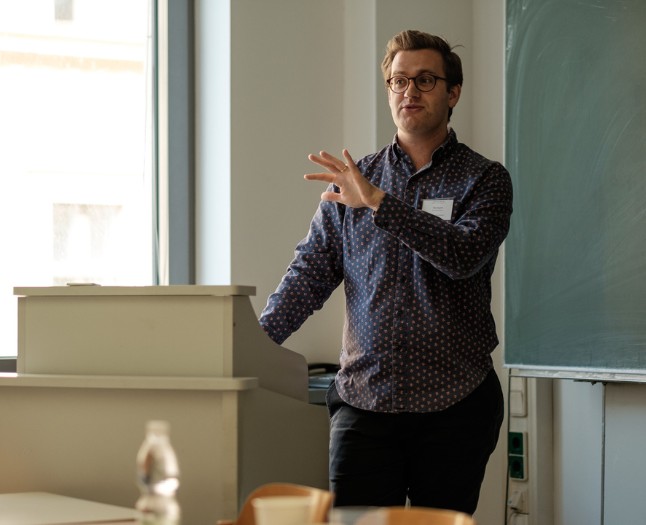
The University of Notre Dame Australia congratulates researcher Tim Smartt for receiving a prestigious fellowship that will advance his work on ethical ways to address misinformation and conspiracy theories.
Dr Smartt was one of eight recipients of the Australian Academy of the Humanities 2026 Humanities Travelling Fellowships for his project Beyond Blame: A New Approach to the Morality of What We Believe.
The fellowships support early-career humanities researchers to undertake critical overseas research, access specialist resources and establish international connections.
Dr Smartt, a Senior Research Fellow in Philosophy at Notre Dame’s Institute for Ethics & Society, has been working on finding ethical ways to reduce misinformation uptake.
He said the standard responses to misinformation assume those who believe it are irrational and blameworthy, but he wanted to develop a new framework for responding with dignity, trust and respect.
“Misinformation and conspiracy theories are one of the most significant challenges facing Australian society,” he said. “They interfere with effective public decision making and fuel social polarisation.
“But the way governments attempt to curb their influence is itself a matter that needs careful moral reflection. Misinformation interventions can themselves be morally better or worse. I have been developing an approach to this issue which eschews moral condemnation and prioritises treating people with dignity, trust and respect.
“I think my approach is promising since many of the punitive misinformation interventions of the last 10 years haven’t worked and have exacerbated social tensions.”
The fellowship will support a three-week research trip to Europe, where Dr Smartt will work with several leading research groups in ethics and epistemology.
This will allow him to refine his framework, obtain expert feedback and build the international connections that will advance his project to the next stage.
“It’s exciting because producing excellent philosophical research involves testing and refining ideas through a process of mutual intellectual exchange,” he said.
“It’s the lifeblood of my discipline in many ways. So it’s great to have support from an external foundation to support this kind of collaboration.
“There’s no substitute for working with, and learning from, experts in your field, many of whom are based outside Australia.”
Dr Smartt’s fellowship dovetails with the work of the Institute’s Dr Adam Piovarchy, who was last year awarded an Australian Research Council Discovery Early Career Researcher Award for a similar research project examining the ethics of blame in modern society.
Institute for Ethics & Society Co-Director, Associate Professor Nathan Lyons, said the fellowship recognised the quality and growing influence of Dr Smartt’s research.
“Tim has spent several years developing this program of research and establishing himself as an important voice in conversations about misinformation, ethics and public trust,” he said.
“This fellowship recognises the strength of his work and will enable him to deepen connections with leading international researchers, bringing new ideas and perspectives back to Australia.”
Media Contact: media@nd.edu.au