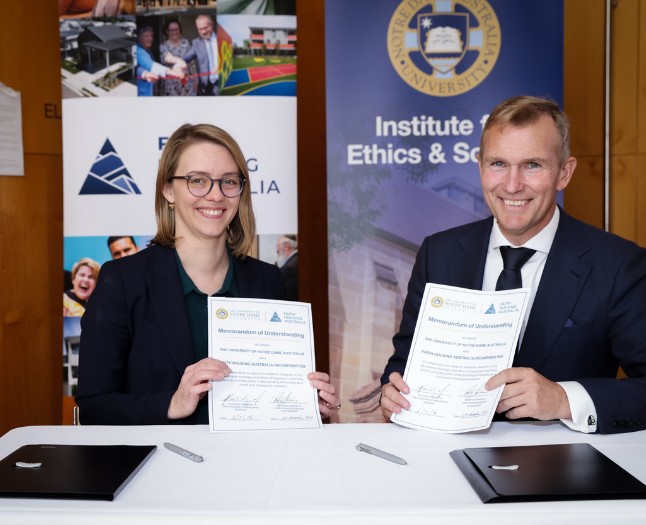
A new collaboration between the University of Notre Dame Australia and Faith Housing Australia will bring Jewish, Christian and Muslim traditions into a national conversation about housing, justice and what we owe one another.
Australia's housing crisis is usually discussed in terms of supply, affordability, planning and investment. But a new national research partnership is asking a more fundamental question: What is a home for and what responsibilities do we have to ensure others can have one?
Notre Dame’s Institute for Ethics & Society and Faith Housing Australia have partnered to launch The Dwelling Project: Theology and Ethics of Housing in Australia, a multi-year research and engagement initiative exploring the moral and ethical dimensions of housing through the intellectual traditions of Judaism, Christianity and Islam.
The project will be officially launched this Friday at The Theology and Ethics of Housing in Australia with Geraldine Doogue, a panel conversation led by acclaimed broadcaster Geraldine Doogue AO with Rabbi Dr Benjamin Elton, Dr Samir Mahmoud, and Professor Sandra Lynch.
Bringing together academic scholarship and the practical experience of faith communities, housing and homelessness organisations, the project will examine how the three major Abrahamic religious traditions understand home, land, property, justice and human flourishing.
The initiative responds to a significant gap in Australia's housing conversation, where economic and policy considerations often overshadow deeper questions about the meaning of home, our responsibilities to one another and the kind of society we want to build.
The project also engages with major faith-based institutions in Australia's housing system. Faith-based organisations deliver more than 20 per cent of Australia's community housing, alongside homelessness services and other forms of community support. Faith institutions also hold significant land and property assets, extensive volunteer networks and longstanding relationships with communities across the country.
The Dwelling Project will pursue three interconnected areas of work:
- Research: Advancing original theological, ethical and interdisciplinary research into housing, home, land, property and human flourishing.
- Faith-sector engagement and institutional practice: Supporting faith leaders and institutions to consider how their values, resources and relationships might contribute to housing justice.
- Public dialogue and engagement: Bringing theological and ethical perspectives into Australia's national housing conversation, enriching public debate and encouraging deeper reflection on justice, belonging and the common good.
Through these activities, the partnership aims to connect rigorous scholarship with practical institutional reflection and wider public engagement, contributing new perspectives to one of Australia's most significant social challenges.
Associate Professor Annette Pierdziwol, Acting Pro Vice Chancellor Research at the University of Notre Dame Australia, said the partnership demonstrated the University's commitment to research that engages with the most pressing questions facing Australian society.
"Some of the most important research in universities begins with questions that matter deeply to the communities we serve and housing is undoubtedly one of the defining issues in Australian civic life,” Associate Professor Pierdziwol said.
“Our partnership with Faith Housing Australia brings together the strengths of a research university and a distinctive national civic organisation, creating an opportunity for research that is intellectually significant and capable of making a real difference.”
Associate Professor Nathan Lyons, Co-Director of Notre Dame's Institute for Ethics & Society, said the project opened a substantial field of inquiry for theologians, ethicists and scholars across disciplines.
"Judaism, Christianity and Islam have centuries of rich and sometimes challenging reflection on property, hospitality, justice and our obligations to one another. These traditions offer intellectual resources that have a great deal to contribute to contemporary debates about housing,” Associate Professor Lyons said.
“There is important work for theologians and ethicists to do in bringing these traditions into conversation with one another and with the realities of Australian society.”
The Hon. Dr Rob Stokes, Chair of Faith Housing Australia, said Australia's housing challenge demanded a broader conversation about the purpose of housing and the responsibilities of society.
"We have become very good at discussing the price of housing, but far less comfortable discussing its purpose,” Dr Stokes said.
"Housing is fundamental to human dignity, family life, community and belonging. It is not simply another commodity, and the consequences of treating it as one are increasingly evident across Australian society.
"Our great religious traditions have wrestled for centuries with questions about property, justice, stewardship and our responsibilities to others. Bringing these perspectives into the public square can help us think more deeply about the values that should underpin our housing system."
Amanda Bailey, Chief Executive Officer of Faith Housing Australia, said the project recognised the distinctive contribution faith communities could make to addressing Australia's housing challenges.
"Faith-based organisations are already among Australia's most significant providers of community housing and homelessness services. But their potential contribution extends well beyond the homes and services they currently deliver,” Ms Bailey said.
"Across Australia, faith communities hold land and property, bring generations of community relationships, and have deep commitments to serving people and places. The question is how we bring those resources, relationships and values together to make a greater contribution to housing justice.
"The Dwelling Project creates an opportunity to connect rigorous theological and ethical inquiry with the practical decisions facing faith leaders and institutions. We want this research to inform real conversations, real choices and, ultimately, real outcomes for communities."
Media Contact: media@nd.edu.au