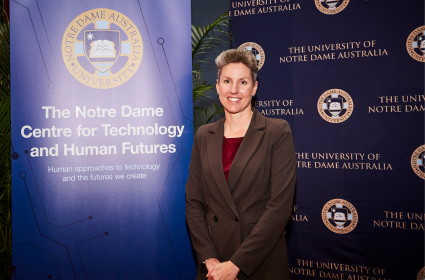
The University of Notre Dame Australia has secured a prestigious Australian Research Council (ARC) Future Fellowship, with Associate Professor Victoria Lorrimar awarded $1,148,446 to lead a four-year research project examining how generative artificial intelligence is reshaping spiritual practice and belief formation in Australia.
Associate Professor Lorrimar, Director of Notre Dame’s Centre for Technology and Human Futures, will lead the project, AI-Mediated Spirituality in Australia: Protecting Wellbeing, Reducing Risk, which will investigate how Australians are using AI for spiritual guidance, personal growth and wellbeing.
The ARC Future Fellowship marks a significant milestone in the University’s growing research profile. It follows Notre Dame’s success in securing three ARC Discovery Early Career Researcher Awards in 2025.
Notre Dame Acting Vice Chancellor Professor Aron Murphy said the Fellowship recognised the University’s commitment to high-quality, humanities-grounded research that responds to some of the most significant questions facing society.
“This is an outstanding achievement for Associate Professor Lorrimar and for Notre Dame,” Professor Murphy said. “Her work reflects the distinctive contribution Notre Dame is making to national and international conversations about technology, ethics, human flourishing and the future of society.”
“As artificial intelligence becomes part of everyday life, it is vital that universities help communities understand both its opportunities and its risks. This Fellowship will support important research that will inform practice, policy and public understanding.”
Associate Professor Lorrimar said the project would examine an emerging area of AI use that has significant implications for individual and community wellbeing.
“Generative AI is increasingly being used not only for work and study, but also for spiritual guidance, personal growth and wellbeing,” Associate Professor Lorrimar said.
“This project will help us understand how Australians are engaging with AI in spiritual contexts, what benefits they may experience, and where risks such as misinformation, echo chambers or harmful beliefs may arise.”
“Medical and therapeutic uses of AI are receiving significant attention, but the spiritual uses are yet to be understood. By mapping how AI is being used for spiritual guidance and personal growth, we hope to provide practical evidence and resources that support safer, more informed and more responsible engagement with these technologies.”
The project will use ethnographic research, surveys and interviews to identify who is using AI for spiritual purposes, how they are using it and what outcomes they experience. The research will consider both the potential benefits, including stronger feelings of purpose and belonging, and the risks, including vulnerability to misinformation and extreme beliefs.
The project aims to support educators, health professionals, spiritual and wellness communities, policymakers and the broader public as AI becomes more deeply embedded in everyday life.
About the Centre for Technology and Human Futures
The Centre for Technology and Human Futures hosts humanities-grounded research on AI and emerging technologies intended to enhance human capacities and advance human flourishing. Its researchers bring philosophical, theological, ethical and social scientific expertise to critical questions about how technology shapes the way people work, teach, learn, play, understand themselves and relate to one another.
Project details
Project title: AI-Mediated Spirituality in Australia: Protecting Wellbeing, Reducing Risk
Funding: $1,148,446
Timeframe: Four years
Lead researcher: Associate Professor Victoria Lorrimar
Host institution: The University of Notre Dame Australia
Media Contact: media@nd.edu.au