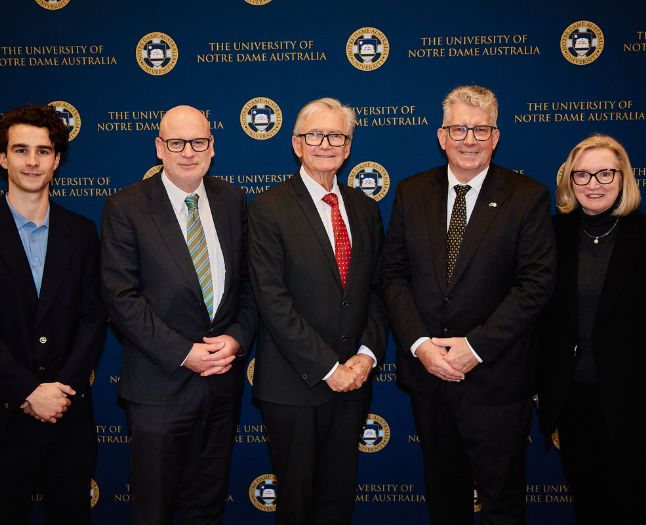
The University of Notre Dame Australia was honoured to welcome Australia’s Ambassador to the Holy See, The Hon Keith Pitt, to its Fremantle Campus for a special lecture on diplomacy, international relations and Australia’s engagement with one of the world’s oldest and most influential diplomatic institutions.
A former federal Cabinet Minister, Ambassador Pitt served Australia in a range of leadership roles, including as Minister for Resources and Water. In his current position, he represents Australia to the Holy See, advancing Australia’s interests through dialogue on global issues including peace, human dignity, humanitarian assistance, technology, safeguarding, social justice and the Pacific.
Ambassador Pitt spoke about the unique role of Australia’s Embassy to the Holy See, which focuses on multilateral engagement rather than consular services or trade negotiations.
“There is a reason there are more than 90 resident embassies to the Holy See,” Ambassador Pitt said. “That is about their level of international diplomacy and their impact on areas of the world that are of interest to us, and interest to the Australian Government and the Australian people.”
Ambassador Pitt said the Holy See’s influence on world leaders, major organisations and global diplomacy was significant, but often exercised quietly.
“As a religious institution, as a global institution, they are the original influencers,” he said. “Their level of international diplomacy and influence is quite simply extraordinary. And you’ll never hear about it. It doesn’t get reported in the media. They don’t put it up in lights. They just do it.”
He said the Holy See’s diplomatic network gave it first-hand insight into many of the world’s most pressing conflicts and humanitarian challenges and that Australia’s presence in Rome was an important way to hear and contribute to those conversations.
Ambassador Pitt also reflected on the influence of Pope Leo XIV, including the Pope’s strong focus on artificial intelligence, human dignity and the future of work.
“The fact that the Holy Father spoke particularly about the dignity of work and the ability of the individual to find their own way and the impact that AI may have on that in the future, I think was a very important intervention,” he said. “To use words like ‘we must disarm AI’ — that’s strong. And it led the news around the world.”
Ambassador Pitt said the Pope’s intervention had already influenced international debate around AI, including in Australia and was expected to shape future discussions in Europe and elsewhere.
“There are a lot of views about artificial intelligence, but I agree with the Pope around the dignity of work, to ensure that it is a tool for humanity to advance it, not to replace it,” he said.
The Ambassador also spoke about the Holy See’s diplomatic role in promoting peace, dialogue and multilateral cooperation at a time of increasing global instability. He said the Pope’s role as a global moral and diplomatic voice was especially important in encouraging dialogue and calling for an end to conflict.
“Diplomacy is the way we’re going to move always,” he said. “Progress may be slow, but progress is progress.”
Executive Dean of the Faculty of Arts, Sciences, Law and Business, Professor Martin Drum, welcomed Ambassador Pitt to the University and thanked him for sharing his unique perspective with the Notre Dame community.
"For a Catholic university, Australia's relationship with the Holy See is of particular interest because it highlights the intersection of faith, public life and international engagement. We are grateful to Ambassador Pitt for sharing his knowledge and experience with our community."
Professor Drum also noted that Ambassador Pitt's work continued the legacy of former Deputy Prime Minister and Nationals MP Tim Fischer by building bridges between Australia and the Holy See.
Ambassador Pitt will also deliver a second lecture at the University's Sydney Campus next week.
Media Contact: media@nd.edu.au