University of Notre Dame Australia researcher Dr Olivia Karaolis is helping reshape how children’s voices are recognised in early learning through her work with portraiture, a research method that blends qualitative inquiry with the arts.
Highlighted in her recent article, “Painting with Children’s Voices: Portraiture as a Participatory Research Methodology with Young Children,” this approach brings children’s voices to the forefront in ways that are both joyful and ethical.
A Senior Lecturer in Special and Inclusive Education, Dr Karaolis’s focus is on how young children communicate and make meaning in diverse ways.
Grounded in the principles of the United Nations Convention on the Rights of the Child (UNCRC, 1989), portraiture highlights recognising ‘goodness’ and paying attention to what is working within individuals and communities.
“Children express meaning in many ways and our responsibility as adults is to value those different expressions,” Dr Karaolis said.
Aligned with Notre Dame’s values of human dignity, social justice and community, as well as its Catholic tradition of nurturing the whole person, her work challenges deficit-based narratives in early childhood education by focusing on children’s strengths.
“Rather than trying to ‘fix’ children, this approach builds on what is already working and recognises them as capable participants in their own lives,” she said.
Dr Karaolis hopes her work encourages educators to rethink how they listen to children.
“Arts-based approaches invite educators to slow down, observe deeply and reflect on what is already working,” she said.
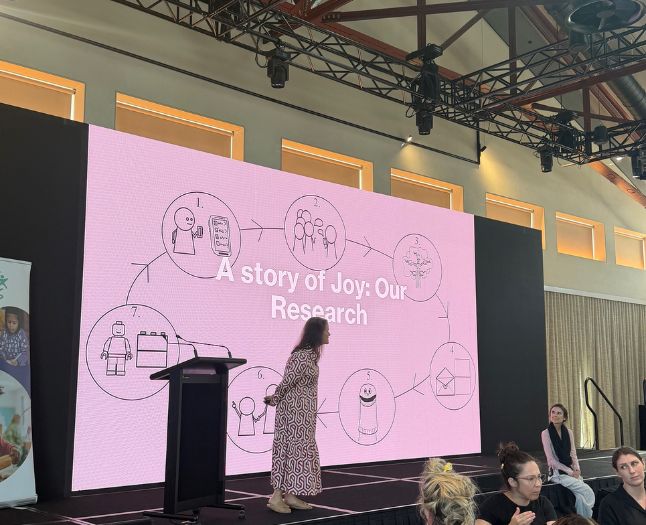
Recently presenting at the Early Childhood Management Systems Professional Learning Conference in Melbourne, Dr Karaolis joined more than 700 educators exploring wellbeing, belonging and culturally responsive practice, contributing to key sector conversations while highlighting Notre Dame’s research and impact.
Driven by curiosity, she emphasises the importance of remaining open in research.
“If we focus on listening carefully and honouring the people we are researching with, rather than researching on, we can learn so much more,” she said.
Dr Karaolis’s newly published paper in the European Early Childhood Education Research Journal, “Beyond Words: Inclusion Through Arts-Rich Experiences,” further explores how children’s participation extends beyond spoken language.
Media Contact: media@nd.edu.au