More than 160 second-year medical students from the University of Notre Dame Australia's Sydney School of Medicine have gained firsthand experience managing emergency situations through the University's annual Rural Trauma Week, a unique immersive program designed to prepare future doctors for rural healthcare practice.
Held over five days in August, Rural Trauma Week combines classroom learning, practical clinical skills training and realistic emergency simulations to expose students to the challenges of trauma management in regional and rural settings.
After an introductory day of lectures on campus, students travelled to Lithgow where they participated in hands-on clinical skills workshops and large-scale trauma scenarios hosted by the Lithgow Rural Clinical School. The program is delivered through a multidisciplinary partnership involving NSW Ambulance, the Lithgow Volunteer Rescue Association and, for the first time this year, St John Ambulance NSW.
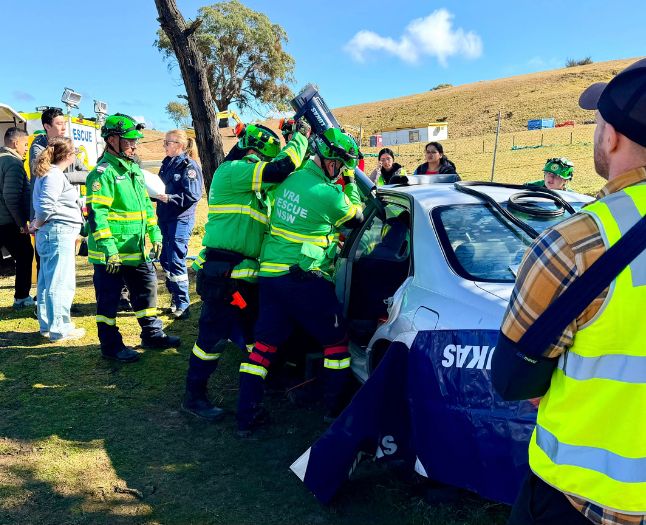
One of the week's most important training activities was a simulated motor vehicle accident involving real wrecked vehicles, volunteer rescue personnel and local school students acting as casualties. The exercise challenged students to assess injuries, manage patients and work collaboratively under pressure in a realistic emergency environment.
Professor Glen Farrow, National Head of Rural Clinical Schools, said the program provides an invaluable opportunity for students to develop practical skills while gaining insight into the realities of rural healthcare.
"Rural Trauma Week is a great example of multidisciplinary learning that brings together healthcare professionals, emergency responders and community organisations to give students an authentic experience of trauma care," Professor Farrow said.
"The program highlights the importance of teamwork, communication and clinical decision-making, while also introducing students to the rewarding opportunities available in rural medicine and community service."
This year's program concluded with advanced clinical simulation training at St John Ambulance NSW Headquarters in Macquarie Park, where volunteer paramedics, nurses and medical staff worked alongside University instructors to deliver realistic emergency scenarios. The collaboration marks a new partnership that organisers hope to continue in future years.
The impact of Rural Trauma Week extends beyond the classroom. Shortly after completing the program, one student encountered a multi-vehicle crash on the Hume Highway and was among the first people to stop and provide assistance. With emergency services delayed, the student worked alongside another doctor to help several seriously injured passengers.
Reflecting on the experience, the student credited Rural Trauma Week with helping them respond confidently in a real emergency.
"I felt an enormous sense of gratitude that my medical training had prepared me to help in that moment, and I was struck by how closely the real event mirrored the simulation," the student said.
"The experience gave me genuine confidence in my DRS ABCDE assessment skills, and it has reinforced Rural Trauma Week as the most valuable part of my medical training so far."
The overwhelmingly positive feedback received from students each year continues to demonstrate the value of immersive rural training experiences in preparing the next generation of doctors to serve communities across Australia.
Media Contact: media@nd.edu.au