
Philosophy in the Abrahamic traditions
What happens when Jewish, Christian, and Muslim thinkers meet on common ground?
At the Notre Dame Centre for the History of Philosophy (CHOP), one of our distinctive emphases is the study of philosophy in the Abrahamic traditions. We explore the philosophical legacies of Judaism, Christianity, and Islam as both distinct intellectual lineages and as overlapping, interwoven traditions of wisdom.
Our Centre serves as a national hub for research, teaching, and public engagement on the history of Abrahamic philosophy. Our programs connect Australian scholarship to a vibrant international network, while partnerships with community institutions bring this work into public life. At a time when social cohesion is under strain in Australia and globally, we see this work as vital and urgent, as well as intellectually enriching.

“Who is wise? One who learns from everyone.”
— Mishnah Avot 4:1, Hoter ben Shelomo (15th‑century Yemen)
Thinking together
Philosophy in the Abrahamic traditions is a deep-rooted, collaborative enterprise, with a remarkable record of Jewish, Christian, and Muslim thinkers meeting across boundaries. One iconic instance is 9th-century Baghdad where, under caliphal patronage, scholars of many faiths translated and commented on Greek, Syriac, Persian, and Sanskrit texts. This movement—often associated with Bayt al‑Hikmah (the House of Wisdom)—created a vibrant intellectual commons where Jewish, Christian, and Muslim thinkers worked side by side. This was one of history’s great experiments in intellectual pluralism.
Similarly, in 12th and 13th-century Toledo, in the heart of medieval Spain, Jewish, Muslim, and Christian scholars collaborated to render Arabic philosophical and scientific texts into Latin and Castilian. These workshops helped transmit Aristotle and his commentators to Latin Christendom, shaping the foundations of European universities. The Cathedral of Toledo itself became a beacon of cross-tradition scholarship.
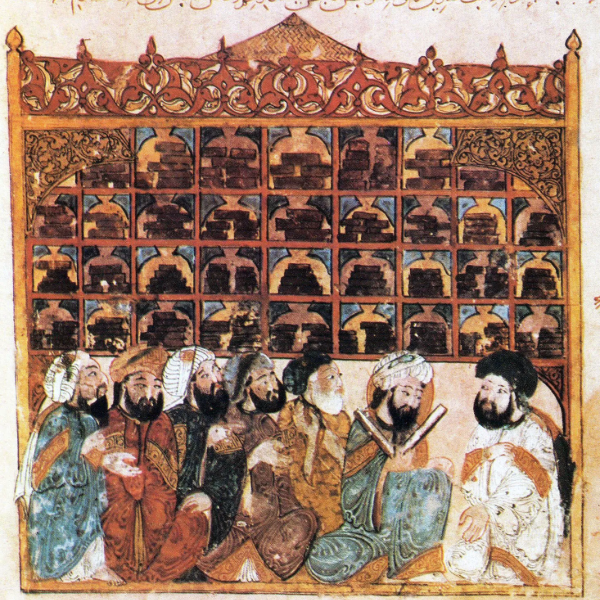
Scholars in Abbasid library - illustration by Yahya ibn Mahmud al-Wasiti in Maqamat al-Hariri manuscript (13th century)
These were not isolated episodes. Across continents and centuries, the traffic of Abrahamic ideas ran constantly. Thinkers like Maimonides, Avicenna, and Aquinas engaged deeply with one another’s work—sometimes in agreement, sometimes in critique. They wrestled with shared questions about God, creation, reason and revelation, and the moral life. Their dialogues show how learning across traditions can sharpen understanding within each.

Toledo Cathedral, west façade
As our Directors, David Bronstein and Nathan Lyons, observe in ABC Religion and Ethics:
“The point of all these cross-tradition conversations wasn’t to agree about everything—which would be both impossible and boring. Rather, like fans of opposing football teams who watch the game together and enjoy it more for that reason, the point was a shared project.
These Abrahamic thinkers worked together on the project of philosophy, which is itself the project of seeking wisdom (sophia, hokhmah, sapientia, hikmah). They worked on shared questions, and thinking together helped each tradition sharpen its own answers to those questions — finding common ground here, differences there — and in the process they made neighbours of each other, intellectually and literally.”
The role of philosophy in the Abrahamic traditions can then be conceived as a well of wisdom and a bridge between communities. Jewish, Christian, and Muslim philosophers have drawn on philosophy to deepen their own wisdom traditions and, in the process, built bridges with their neighbouring Abrahamic communities.
Why it matters now
In recent years, antisemitism and Islamophobia have surged to alarming levels in Australia. Jewish and Muslim communities face threats to their safety, dignity, and inclusion. The Australian Special Envoy reports on Antisemitism and Islamophobia released in 2025 describe this as a national crisis that undermines democracy and corrodes social cohesion.
CHOP’s work responds to this crisis by offering a constructive model for learning together. The history of Abrahamic philosophy shows that rigorous engagement across traditions can deepen commitments while creating common ground without erasing difference. We hope and believe that philosophy can help—in a modest way—to rebuild trust among Abrahamic communities today. Our conviction is simple, and it inspires all our work in Abrahamic philosophy: if we can think together, maybe we can live together.
Contact us
If you would like to know more about what we do at the Notre Dame Centre for the History of Philosophy, we encourage you to email us chop@nd.edu.au.
Connect with Notre Dame on Social Media
Australia
Fremantle
Broome
Sydney